

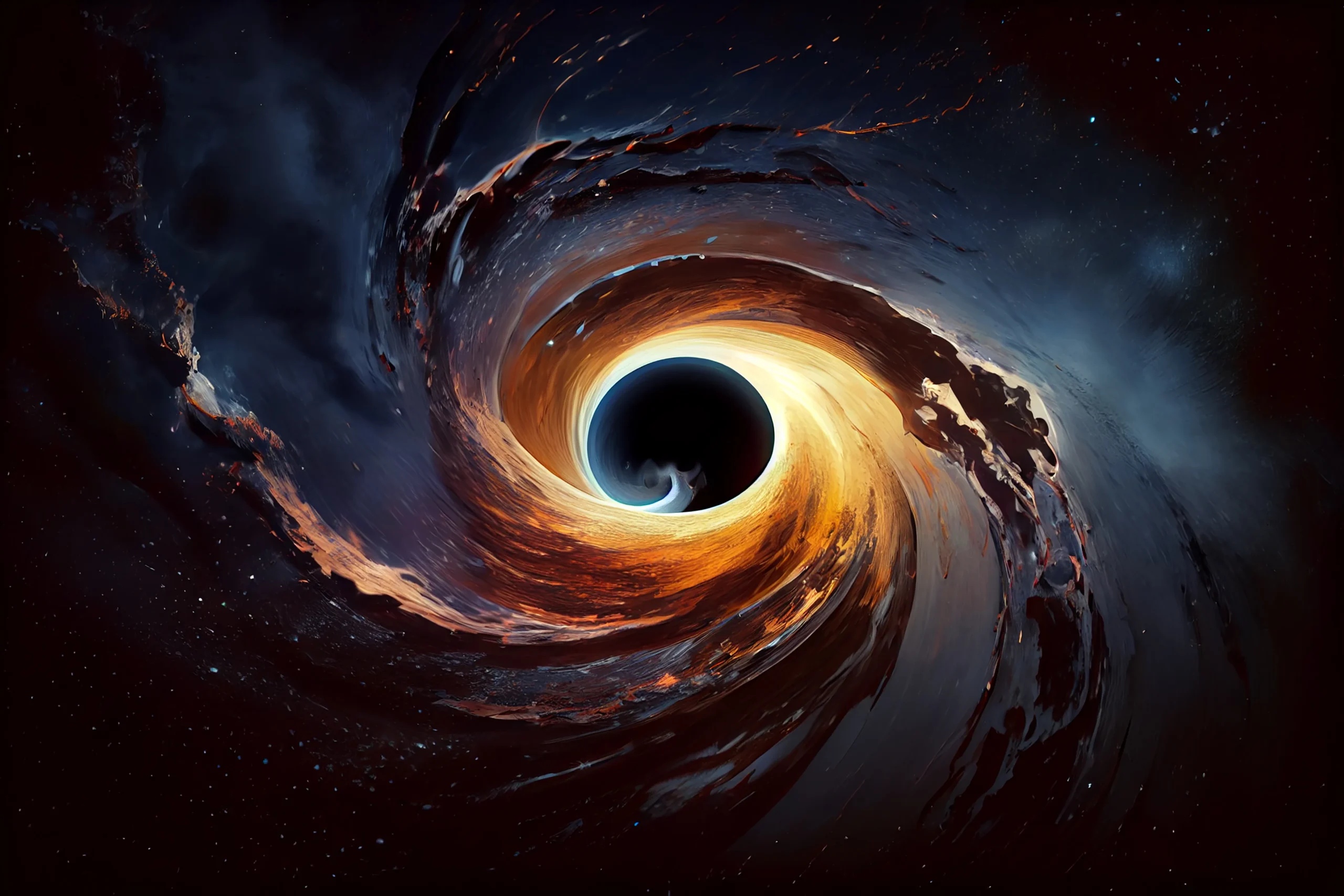
Black holes are considered to be some of the most mysterious and fascinating object in the universe. These are the space areas where the force of gravity is severe that nothing, not even light, can escape out of them. This excessive gravitational attraction renders black holes invisible but their existence can be evidenced by their effect on other bodies.
The black holes are known to be formed when the massive stars die at the end of their life cycle. A massive star collapses due to its gravitational force when it has exhausted all its fuel. When the rest of the core is concentrated enough it creates a black hole.
A black hole is divided into a number of crucial components. The horizon that encloses the black hole is known as the event horizon where nothing can escape. When the object passes this boundary, it falls into the black hole. The point in the center of a black hole is known as the singularity where it is assumed that the power of gravity is infinitely high.
Black holes can vary in size. There are those that are small and composed of collapsing stars and the other supermassive ones found at the galaxy centres. These enormous black holes are a million, or even a billion times heavier than the Sun is.
Black holes are not observable directly but scientists observe them based on their influence on the surrounding stars and gas. When matter is attracted into a black hole, it will create a rotating disk and give out radiation and this can be detected using telescopes.
The black holes are also significant in galaxy structure. They are able to shape the motion of stars and the shaping of the cosmic structures.
Black holes, though very enigmatic, are a significant scientific field of study. Their study aids scientific experts in comprehending the gravity, space, and the laws of physics.
By and large, the black holes are one of the most extreme occurrences in the universe. Their research still offers a good contribution to the nature of space and the forces controlling the space.